Debugger Interface
The debugger is able to perform the following operations through the Debug Module:
-
Halt the hart.
-
Cause an instruction to be executed on a halted hart.
-
Read the shared data register.
-
Write the shared data register.
No specific implementation of those primitives is required. Two possibilities are below.
Minimum Gates
This implementation attempts to use as few gates as possible and is suitable for very simple cores.
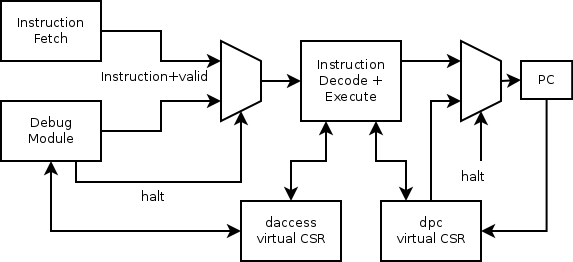
When halted, instructions (and a valid signal) come from the Debug Module instead of the Instruction Fetch unit. Incrementing the PC is inhibited so no separate register is needed to store the PC. Instead accessing dpc modifies the actual PC register. (I’m assuming there is such a thing.) Accessing the daccess CSR really translates into an access to the Debug Module to enable exchanging data.
Bus Slave
This implementation places the Debug Module on the System Bus and has the hart fetch instructions as usual. It requires only minimal and straightforward changes to the core itself.
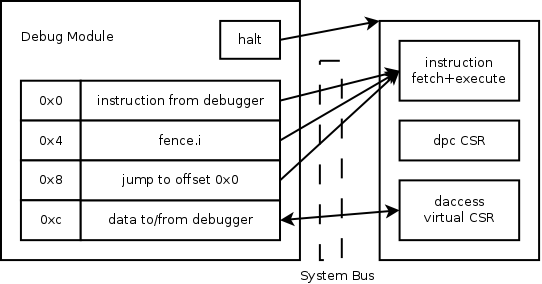
When halt is asserted, the hart takes an exception, saving PC to the dpc CSR, and it jumps to the address in memory where the Debug Module lives. The Debug Module satisfies accesses to 0x0 in its memory space with instructions it gets from the debugger. Data is exchanged through a special CSR. Accesses to this CSR are equivalent to lw/sw instructions to 0xc in the Debug Module.